
By DeepDive Editorial Board | Regional Security & Intelligence Bureau
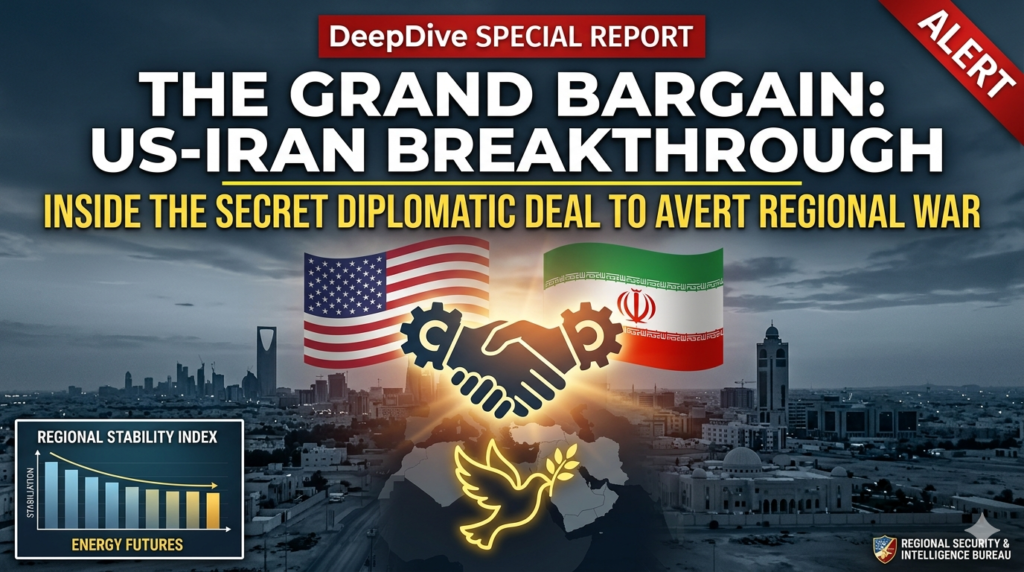
AL JUBAIL — Following eighteen months of strictly classified backchannel negotiations conducted across neutral capitals, the United States and the Islamic Republic of Iran have finalized a comprehensive strategic framework. Designed to systematically de-escalate the multi-theater proxy conflicts across the Middle East and restructure the nuclear standoff, this accord represents the most significant shift in Western-Iranian relations in over four decades. Observers are already calling the landmark agreement “The Grand De-escalation Bargain.”
The deal arrives at a critical juncture. Over the past year, iterative regional clashes—spanning Persian Gulf shipping lanes, the Levant, and the Red Sea—had continually threatened to ignite a direct, uncontained conventional war between Washington and Tehran. This investigative report dissects the architecture of the agreement, the secret diplomatic balancing acts that forged it, and the immediate implications for global energy security, military posturing, and alliance structures.
I. The Genesis of the Backchannel
The roadmap to this historic understanding did not emerge from public international forums, but rather through highly sensitive, deniable diplomatic pipelines established in Muscat, Oman, and Doha, Qatar. According to intelligence sources, the initial breakthrough occurred in late 2025, following a volatile cycle of ballistic missile exchanges and drone strikes that brought regional infrastructure to the brink of collapse.
Recognizing that standard deterrent protocols were failing and that an inadvertent escalation could trigger a full-scale war, mid-level officials from the U.S. National Security Council (NSC) and Iran’s Supreme National Security Council began a series of proximity talks. These sessions were meticulously insulated from media scrutiny. The resulting framework addresses three distinct, codependent pillars: the structural containment of Iran’s nuclear enrichment capacity, an explicit regional non-aggression/proxy-management compact, and the phased unwinding of corresponding economic sanctions.
Key Mechanism: The Synchronization Protocol
Unlike previous accords which relied heavily on front-loaded concessions, the 2026 framework utilizes a strict “Step-for-Step” verification matrix. Neither Washington nor Tehran is required to execute unilateral policy adjustments without verifiable, concurrent compliance from the opposing signatory, supervised by designated international intermediaries.
II. Architectural Pillars of the Accord
The stabilization package is structurally divided into distinct operating spheres, ensuring that technical nuclear oversight is coupled directly with regional security commitments.
1. Nuclear Retrenchment and Enhanced Verification
Tehran has formally committed to capping its uranium enrichment operations at a maximum purity threshold of 3.67%—a complete reversal from the volatile 60% stockpiles accumulated over recent years. In return, the existing inventory of highly enriched uranium (HEU) will be systematically blended down to low-enriched forms or transported out of the country to designated third-party facilities under International Atomic Energy Agency (IAEA) custody.
Crucially, Iran will reinstate the full suite of monitoring mechanisms under the IAEA’s Additional Protocol. This guarantees international inspectors continuous, unhindered electronic tracking and snap-inspection access to key operational sites, including the deeply fortified installations at Natanz and Fordow.
2. The Regional Stability Matrix & Proxy Management
Addressing Western concerns regarding asymmetrical warfare, the agreement outlines a strict code of conduct for regional non-state actors. Tehran has agreed to exercise its substantial leverage to halt advanced ballistic missile and kamikaze drone transfers to regional aligned groups in Yemen, Iraq, and Syria.
Concurrently, the United States has agreed to recalibrate its offensive military posture in the region, shifting from active cross-border strike operations to a purely defensive containment architecture. Maritime corridors throughout the Strait of Hormuz and the Bab al-Mandeb will be governed by a newly established hot-line communication protocol between the U.S. Fifth Fleet and the Iranian regular navy to prevent tactical miscalculations.
Framework Matrix: Core Operational Commitments
| Core Operational Area | Iranian Commitments | United States Commitments |
| Nuclear Enrichment | Cap enrichment at 3.67%; blend down or export 60% stockpiles; reinstate IAEA snap inspections. | Support civilian nuclear cooperation waivers for peaceful medical and energy research. |
| Asymmetric Warfare | Cease supply of precision-guided munitions and long-range UAVs to regional non-state actors. | Suspend retaliatory airstrikes on regional infrastructure; transition to defensive maritime positioning. |
| Economic Architecture | Re-integrate financial networks with international transparency standards. | Phased lifting of secondary banking sanctions; unfreeze sovereign oil revenue assets globally. |
| Maritime De-confliction | Maintain standard freedom of navigation in the Persian Gulf; establish tactical communication hotlines. | Reduce high-profile carrier strike group deployments; coordinate maritime security channels via ombudsmen. |
III. Economic Unwinding and Asset Regularization
The financial incentives driving the agreement are substantial for an Iranian economy currently managing severe systemic inflation and currency devaluation. The United States Treasury Department will issue a series of conditional waivers targeted directly at secondary sanctions, effectively allowing international conglomerates to resume purchasing Iranian crude oil and petrochemical derivatives without legal penalty.
Furthermore, billions of dollars in sovereign Iranian revenues, previously immobilized within South Korean, Japanese, and European financial institutions due to clearing restrictions, will be systematically transitioned into monitored escrow accounts. These funds are legally earmarked exclusively for humanitarian acquisitions, including medical technology, agricultural machinery, and critical civilian infrastructure upgrades.
IV. Geopolitical Repercussions and Domestic Resistance
While the diplomatic breakthrough effectively defuses an immediate flashpoint for a global conventional war, it introduces severe friction into established regional alliances. The geopolitical map is adjusting in real-time to the new diplomatic reality:
- The Israeli Defensive Stance: Jerusalem has voiced profound skepticism regarding the verification capabilities of the deal. Senior defense officials emphasize that Israel reserves the right to execute independent preventative military maneuvers if intelligence suggests clandestine enrichment activities persist outside monitored facilities.
- Gulf Cooperation Council (GCC) Realignments: Regional capitals are pursuing pragmatic hedging strategies. While welcoming the reduction in direct drone and missile threats, Gulf states are simultaneously upgrading internal defense systems and expanding economic partnerships to ensure security independent of shifting Western priorities.
- The Eurasian Alignment: The deal carries significant implications for Moscow and Beijing. A diplomatic normalization with the West could alter the velocity of Iran’s defense and energy integrations with Eastern powers, restructuring supply chains and strategic agreements across Eurasia.
V. DeepDive Analytical Outlook: A Fragile Equilibrium
The 2026 U.S.-Iran deal is fundamentally not an explicit peace treaty built on mutual trust; rather, it represents a highly transactional, closely monitored management framework born out of mutual exhaustion and a shared fear of catastrophic war. The architectural durability of the pact rests entirely on the verification protocols managed by international monitors.
For global markets, the reduction in risk premiums has immediately stabilized energy futures and secured vital commercial shipping routes. However, with intense legislative opposition brewing within both the U.S. Congress and conservative factions in Tehran, the coming months will test whether this diplomatic breakthrough transforms into a durable, multi-year security architecture or serves merely as a temporary truce in an ongoing systemic conflict.