
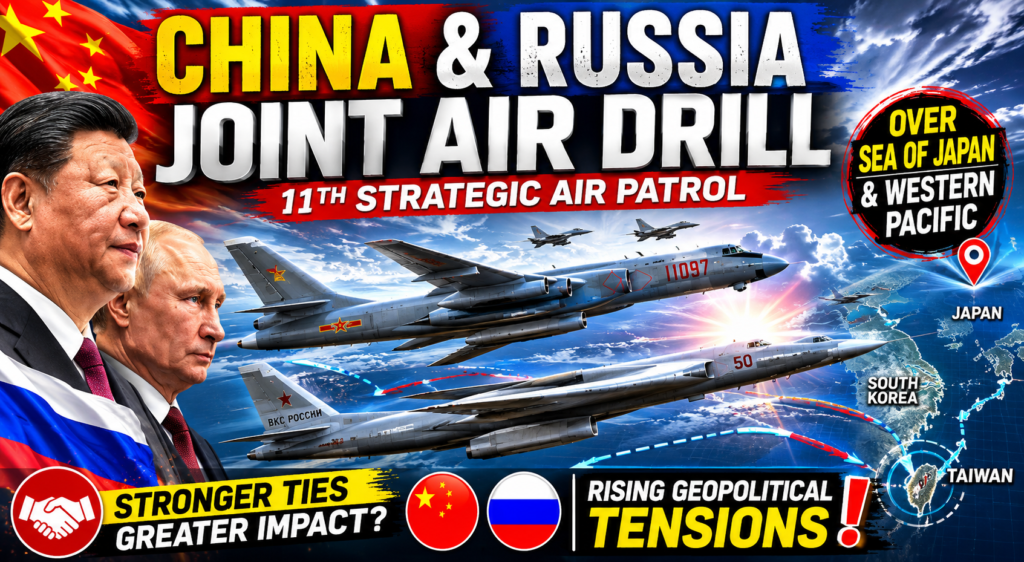
China and Russia have carried out their 11th joint strategic air patrol over the Sea of Japan and the Western Pacific, highlighting the growing military cooperation between the two countries and drawing renewed attention to security dynamics in the Indo-Pacific region.
According to official statements from the Chinese Ministry of National Defense, the exercise was conducted as part of the annual military cooperation plan agreed upon by Beijing and Moscow. The mission involved long-range strategic bombers and supporting aircraft from both air forces operating together in international airspace.
Chinese officials emphasized that the joint air patrol was not directed against any third country and was designed to enhance coordination, improve interoperability, and strengthen the strategic partnership between the two militaries. Russia also described the operation as a routine exercise aimed at increasing operational readiness and deepening bilateral defense cooperation.
The patrol took place over the Sea of Japan and the Western Pacific, regions that are strategically important due to their proximity to Japan, South Korea, Taiwan, and the broader Indo-Pacific. Such operations are closely monitored by neighboring countries, and in previous joint patrols, Japan and South Korea have scrambled fighter jets to track the movements of Chinese and Russian military aircraft.
The latest exercise comes at a time of heightened geopolitical tensions in East Asia, where regional security concerns have intensified due to military activities involving China, Russia, the United States, and its allies. Analysts believe that these joint patrols demonstrate the increasingly close strategic relationship between Beijing and Moscow, particularly amid ongoing global tensions and changing security alliances.
Defense experts note that while China and Russia insist the drills are routine and defensive in nature, the frequency and scale of their joint military exercises send a strong signal about their expanding military coordination. These patrols also serve as an opportunity for both nations to test long-range operational capabilities, command coordination, and joint mission planning.
The exercise is expected to prompt continued surveillance and monitoring by regional powers, including Japan, South Korea, and the United States, which maintain a significant military presence in the Indo-Pacific. Observers believe that such activities will continue to influence the region’s security environment and contribute to ongoing geopolitical competition in the Western Pacific.
The 11th joint strategic air patrol reflects the deepening defense partnership between China and Russia, underscoring their shared commitment to expanding military cooperation while adding another layer of complexity to the evolving geopolitical landscape in the Asia-Pacific region.



jSGZwUJIErBbyuxqXUOVLp