The announcement of a breakthrough Memorandum of Understanding (MoU) between the United States and Iran marks a historic, if highly precarious, pivot point for global geopolitics and energy markets. Aimed at bringing a definitive end to the devastating recent Middle East conflict and guaranteeing the unconditional reopening of the critical Strait of Hormuz, the diplomatic roadmap sets the stage for formal peace talks scheduled to commence on June 19, 2026.
While global leaders, including the G7 presidency and Pope Leo XIV, have enthusiastically welcomed the diplomatic breakthrough as a triumph of international mediation, financial and commodity markets are flashing signs of intense caution. A complex mix of historic inventory depletion, deep-seated structural mistrust, and an immediate outbreak of fresh violence in southern Lebanon has left market participants questioning whether this MoU is a true structural turning point or merely a temporary tactical pause.
1. The Strategic Blueprint of the MoU and the Reopening of Hormuz
The centerpiece of the US-Iran accord is the immediate cessation of maritime hostilities and the full stabilization of the Strait of Hormuz—the world’s most critical energy transit chokepoint. During the peak of the recent conflict, disruptions and security threats in the Strait effectively choked off a significant portion of global crude oil and liquefied natural gas (LNG) supplies, sending shockwaves through international supply chains.
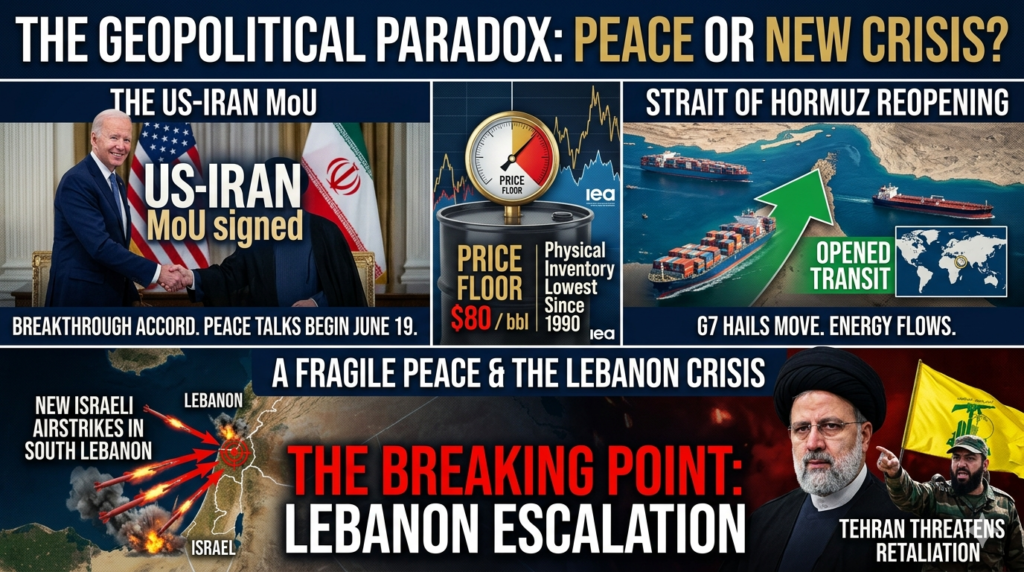
The newly minted MoU provides a phased framework under which maritime transit guarantees will be enforced by neutral international observers, accompanied by a reciprocal reduction in aggressive naval postures. G7 leaders issued a joint statement praising the agreement as a vital milestone for global economic security, emphasizing that free navigation through the Persian Gulf is non-negotiable. From the Vatican, Pope Leo XIV issued a solemn blessing for the upcoming June 19 negotiations, calling on all signatories to transform a paper agreement into a lasting architecture of regional reconciliation.
2. Market Analysis: Why Oil Prices Refuse to Capitulate Below $80
In standard geopolitical cycles, a major peace accord involving a dominant OPEC producer triggers an immediate, sharp sell-off in crude futures as the “war premium” evaporates. However, Brent and WTI crude continue to trade just below the $80-per-barrel threshold. This persistent price floor is driven by two powerful counter-weights: extreme physical inventory depletion and structural market skepticism.
The IEA Inventory Alarm: According to the latest data released by the International Energy Agency (IEA), OECD commercial oil stocks have plummeted to their lowest levels since 1990. Aggressive, emergency drawdowns utilized to keep global refineries operational during the height of the conflict have left the industrialized world with virtually zero cushion against future supply shocks.
Key Geopolitical & Energy Indicators:
- Brent Crude Price: Trading at $78.50 – $79.80 / bbl. Refuses to break significantly below $80; the war premium is being rapidly replaced by a structural deficit premium.
- OECD Oil Stocks: Lowest level since 1990. Severe physical depletion means global supply chains are highly vulnerable, requiring months of sustained re-stocking.
- Strait of Hormuz Status: Transitioning to Open. Sellers remain highly cautious until physical tankers successfully navigate the corridor without inflated war-risk insurance premiums.
Refiners and institutional energy traders recognize that even if the Strait of Hormuz functions perfectly tomorrow, filling the global supply void will take months of uninterrupted production. Consequently, the market has not priced in a supply glut; instead, it is pricing in a long, expensive rebuilding phase of global energy reserves.
3. The Lebanon Escalation: A Fragile Framework Under Immediate Strain
The ink on the US-Iran MoU was barely dry when the structural fragility of the broader regional security architecture was laid bare. Fresh Israeli airstrikes have targeted southern Lebanon, aimed at neutralizing forward missile positions. The kinetic action has immediately drawn fierce condemnation from Tehran and sparked vows of severe retaliation from Iranian military factions and regional aligned networks.
This localized escalation underscores a profound geopolitical reality: the US-Iran diplomatic channel is heavily decoupled from the realities on the ground in the Levant. While Washington and Tehran may agree on maritime economics and direct conflict limitation, proxy networks and peripheral theaters retain the capacity to completely derail the formal peace talks before they even begin on June 19.
If Iranian military factions execute a major counter-response against Israeli targets, the MoU could be rendered dead on arrival. Market participants are keeping a close eye on this fault line. The fear is that a localized escalation in Lebanon could inadvertently drag regional state actors back into direct confrontation, closing the Strait of Hormuz once again and triggering an unprecedented energy crisis given the already depleted OECD stockpiles.
4. Outlook for the June 19 Peace Talks and Investor Strategy
As the international community counts down to June 19, investors, corporate boards, and policy analysts must prepare for heightened volatility. The primary benchmarks for success in the upcoming formal talks will include:
- The formalization of maritime monitoring protocols in the Persian Gulf.
- A clear, conditional timeline for the unwinding of conflict-related sanctions.
- A framework or back-channel mechanism to manage peripheral flashpoints like Lebanon.
DeepDive Verdict: For global markets, the path of least resistance for energy prices remains volatile and skewed to the upside if the Lebanon crisis broadens. True stabilization will only be achieved when OECD inventories begin a sustained upward trajectory and physical cargo insurance rates in the Persian Gulf normalize. Until then, the US-Iran peace deal remains a highly promising, yet deeply fragile, diplomatic experiment.