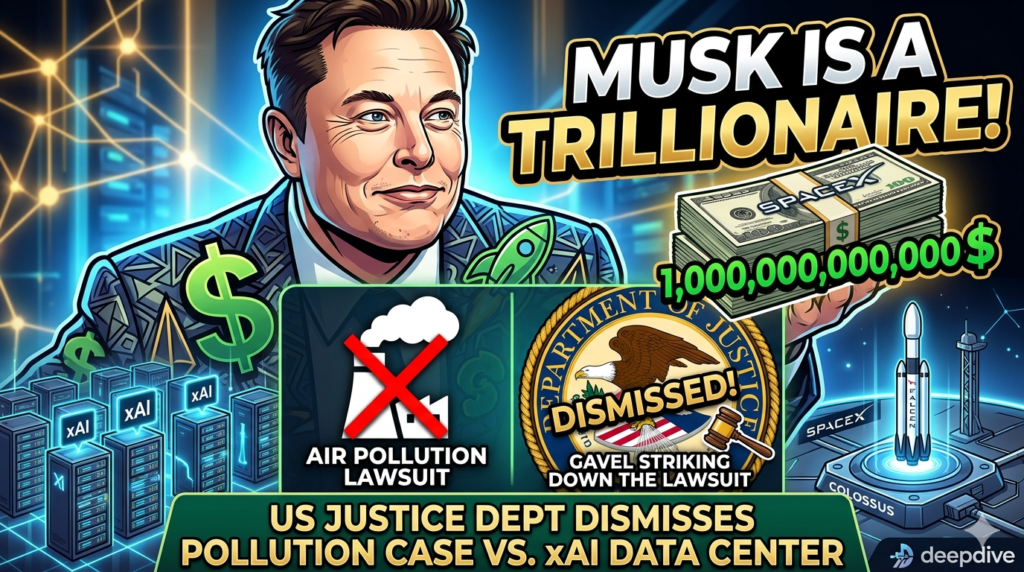

Two tectonic headlines have collided at the intersection of Silicon Valley, Wall Street, and Washington, D.C., outlining a new paradigm of corporate and political influence.
Elon Musk has officially crossed the threshold to become the world’s first verified trillionaire. Concurrently, in a highly unusual legal maneuver, the U.S. Justice Department has moved to dismiss a major environmental lawsuit targeting Musk’s xAI data center operations.
Combined, the stories illustrate a staggering reality: a single individual now wields economic power rivaling major nations, backed by a federal apparatus that increasingly views his technology infrastructure as an untouchable asset of national security.
Part I: The Making of the First Trillionaire
Musk’s ascent to trillionaire status did not come from his traditional flagship, Tesla, which has traded sideways through much of 2026. Instead, it was propelled by the blockbuster initial public offering (IPO) of SpaceX.
On June 12, 2026, SpaceX debuted on the Nasdaq under the ticker symbol SPCX, pricing its shares at $135 and closing its first day of trading at $160.95. The explosive debut immediately pushed SpaceX’s corporate valuation past $2 trillion, securing its spot as the sixth-largest public company on Earth.
| Metric | Details |
| SpaceX IPO Price | $135 / share |
| Day 1 Close Price | $160.95 / share |
| Capital Raised | ~$75 Billion (Largest IPO in history) |
| Musk’s Equity Stake | 42% (~4.8 Billion shares) |
| Total Estimated Net Worth | ~$1.14 Trillion |
The Scale of $1 Trillion
To put Musk’s wealth into perspective, his net worth now surpasses the individual Gross Domestic Product (GDP) of all but 19 countries on Earth. According to data from Oxfam America, his fortune is now greater than the combined wealth of the bottom 46% of the global population.
While critics point to this milestone as the absolute pinnacle of a modern “Gilded Age,” Musk’s underwriters at Goldman Sachs and Morgan Stanley pitched a wildly ambitious future to investors. SpaceX is positioning itself not just as a rocket company, but as the hardware backbone for the artificial intelligence boom, outlining future plans for orbital data centers capable of routing massive computational power globally.
Part II: The Federal Shield Over xAI
As Musk’s financial status reached the stratosphere, his artificial intelligence venture, xAI, received an extraordinary assist from the federal government.
The U.S. Justice Department filed a motion to intervene in and completely dismiss a civil rights and environmental lawsuit brought by the NAACP and Earthjustice against xAI’s massive $20 billion data center operations (which host the “Colossus” supercluster).
The Lawsuit
Filed by local community groups, the lawsuit alleges that xAI illegally constructed and operated dozens of portable, natural-gas-burning turbines in Southaven, Mississippi (near Memphis, Tennessee) to meet the immense electricity demands of the data center. The plaintiffs argue that xAI skipped mandatory Clean Air Act permitting, operating the turbines near residential homes, schools, and churches, and exposing historically marginalized communities to significant respiratory health risks.
The DOJ’s Intervention
Instead of enforcing environmental compliance, the Trump administration’s Justice Department took the unprecedented step of asking the court to throw the lawsuit out entirely. The government’s core arguments include:
- National Security Imperative: The DOJ explicitly argued that the xAI data center is “critical to the economy” and directly supports the U.S. military’s integration of advanced artificial intelligence into tactical operations.
- Executive Branch Preemption: In a bold constitutional argument, Associate Attorney General Stanley Woodward stated that the “ultimate responsibility for enforcing federal law belongs to the Executive Branch, not private interest groups,” asserting that the government has the sole authority to block “citizen suits” if they conflict with federal priorities.
- Regulatory Backlash: The administration stated that “overly burdensome regulation, including private lawsuits… can threaten technological growth, American energy independence, and national security.”
The Legal Backlash: Environmental law experts have called the DOJ’s move “audacious” and “radical,” warning that if the courts accept this rationale, it could effectively dismantle the “citizen suit” provisions embedded in major environmental legislation since the 1970s, letting powerful corporations off the hook for explicit statutory violations.
The DeepDive Takeaway
This week marks a fundamental shift in how private enterprise interacts with sovereign power. Musk is no longer just a wealthy contractor for NASA or a prominent tech executive; his business entities have become fundamentally intertwined with the U.S. government’s geopolitical strategy.
When an individual’s personal wealth exceeds a trillion dollars at the exact moment the Department of Justice redefines environmental law to protect his private data centers, the line between corporate empire and state apparatus ceases to exist. For tech giants rushing to build the infrastructure of the AI age, the message from Washington is unmistakable: innovation and national security trump regulation, every single time.