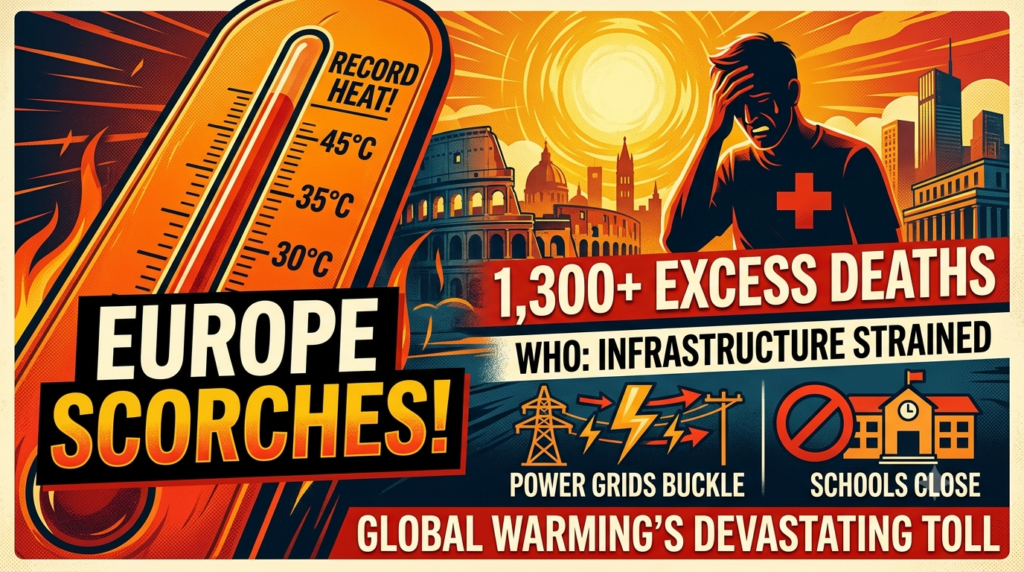
A severe and record-breaking heatwave has gripped Europe, resulting in more than 1,300 excess deaths since June 21, 2026. According to the World Health Organization (WHO), the extreme temperatures have triggered a widespread public health and infrastructure crisis across the continent.
WHO Director-General Tedros Adhanom Ghebreyesus warned that over 150 million people are currently living under extreme heat conditions, describing heat stress as a “silent killer.”
Critical Impacts Across the Continent
The prolonged heatwave is pushing European infrastructure and public systems past their breaking points:
- Surging Mortality Rates: France alone reported roughly 1,000 additional deaths over just three consecutive days at the height of the heatwave, with senior citizens (aged 65 and older) accounting for 85% of the fatalities.
- Power Grids Under Strain: Electricity grids are buckling under unprecedented demand as citizens rely heavily on cooling systems, raising fears of widespread blackouts.
- School Closures: Educational institutions across multiple nations have been forced to suspend classes, as older school buildings lack the ventilation or air conditioning required to keep students safe.
- Shattered Records: Temperatures have soared past historical averages. Germany clocked a staggering daytime record of 41.5°C (106.7°F), while the Czech Republic breached 40.6°C for the first time in its history. Even nighttime temperatures failed to provide relief, staying as high as 29.4°C in parts of central Europe.
Understanding “Excess Deaths”
In public health, excess deaths refer to the number of deaths reported above what would normally be expected for that specific time of year. This statistical measure captures both direct casualties (like heatstroke) and indirect casualties (such as heart attacks or medical complications exacerbated by extreme weather).
The Climate Change Connection
Climate scientists and the WHO emphasize that these extreme events are a direct consequence of global warming. Europe is currently the fastest-warming continent on Earth, heating up at roughly twice the global average rate.
Officials noted that extreme heat events historically classified as “once-in-a-generation” are now occurring nearly annually because of shifting global climate patterns. Public health agencies are urgently calling on European nations to upgrade infrastructure, as the continent’s homes, workplaces, and schools were fundamentally not built to withstand such intense tropical temperatures.