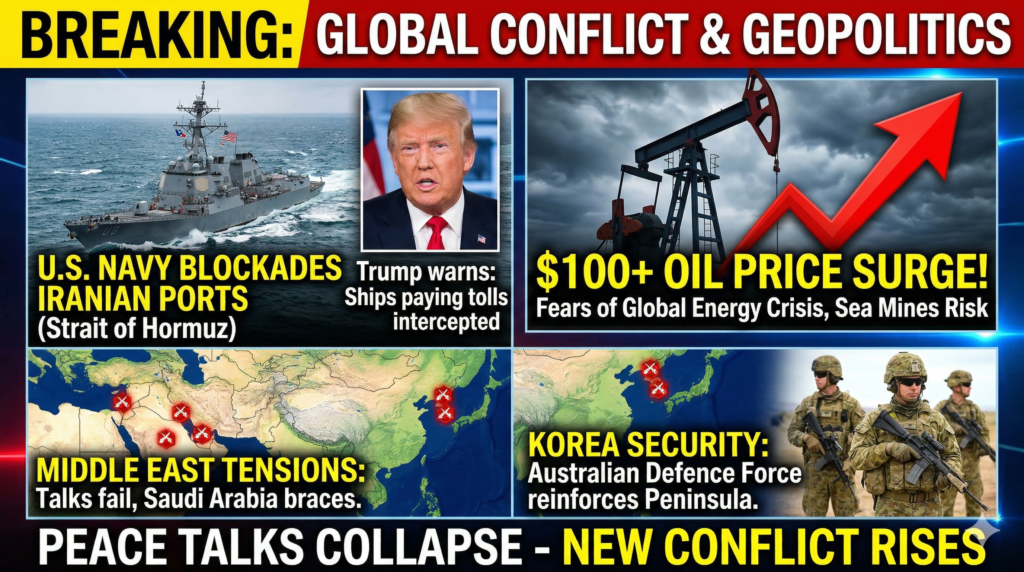

Following the collapse of marathon peace talks led by Vice President J.D. Vance, President Donald Trump officially authorized a naval blockade of all Iranian ports. The blockade, which commenced at 10:00 a.m. ET today, specifically targets vessels entering or departing Iranian coastal areas in the Persian Gulf and the Gulf of Oman.
- Enforcement: U.S. Central Command (CENTCOM) is enforcing the blockade “impartially against vessels of all nations.”
- The “Toll” Conflict: The U.S. move is a direct response to Iran’s attempts to charge “tolls” (reportedly up to $1 per barrel) for passage through the Strait of Hormuz. President Trump warned that any Iranian fast-attack ships attempting to interfere with the blockade or harass commercial traffic would be “immediately eliminated.”
- Scope: While Iranian ports are sealed, the U.S. has clarified that ships transiting between non-Iranian ports will—in theory—be permitted to pass, though maritime traffic has slowed to a crawl.
Oil Markets in Crisis
The energy sector has reacted with volatility not seen in years. Crude oil prices have surged past the $100 per barrel threshold, with Brent crude hitting $102.31 and WTI climbing to $104.43 in early trading.
The spike is driven by two primary fears:
- Supply Disruption: The potential loss of up to 2 million barrels per day of Iranian-linked flows.
- Maritime Hazards: Reports of sea mines in the Gulf of Oman have caused insurance premiums for tankers to skyrocket, with many shipowners refusing to enter the region regardless of the U.S. naval presence.
Regional Stability: Saudi Arabia’s Pipeline Pivot
Amidst the chaos, Saudi Arabia has successfully restored its East-West Pipeline to full capacity (approximately 7 million barrels per day). The pipeline is now the Kingdom’s primary export route, bypassing the volatile Strait of Hormuz by transporting oil to the Red Sea port of Yanbu. This restoration follows a series of recent attacks on pumping stations and the Manifa oil field that had temporarily throttled output.
Asia-Pacific: ADF Reinforcements in Korea
While the Middle East commands global attention, the Australian Defence Force (ADF) has moved to bolster security on the Korean Peninsula. Participating in Exercise Freedom Shield 26, Australian personnel are working alongside the U.S. and Republic of Korea (ROK) under the United Nations Command.
- Objective: To maintain the 1953 Armistice and deter regional provocations during this period of global instability.
- Presence: The deployment includes members from all branches, with the Royal Australian Navy’s HMAS Toowoomba and Warramunga conducting patrols to enforce UN sanctions (Operation Argos) against North Korea.