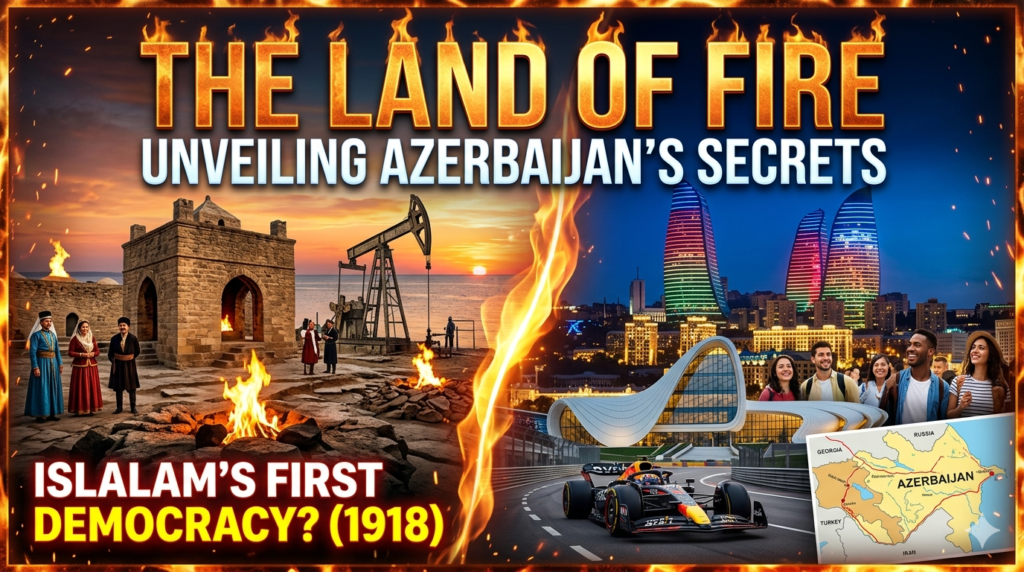

Azerbaijan, globally renowned as the “Land of Fire,” is a captivating country nestled at the crossroads of Eastern Europe and Western Asia. Bounded by the Caspian Sea to the east and the Caucasus Mountains to the north, Azerbaijan boasts a rich tapestry of history, where ancient traditions seamlessly blend with ultra-modern progress.
Let’s take a detailed look into the fascinating eras that have shaped the destiny of this resilient nation.
1. Ancient Beginnings and the “Land of Fire”
Human habitation in Azerbaijan dates back to the Stone Age. The remarkable rock carvings at Gobustan National Park, located just outside Baku, provide a visual diary of prehistoric life, showcasing ancient rituals, dances, and wildlife.
- Zoroastrianism (Fire Worship): Azerbaijan’s terrain is rich in natural gas and oil reserves. In ancient times, these gases would escape through fissures in the earth and spontaneously ignite. Witnessing these eternal flames, ancient peoples revered the land, and Azerbaijan became a major center for Zoroastrianism. The famous Ateshgah (Fire Temple) in Baku stands today as a testament to this mystical past.
2. The Islamic Golden Age and the Shirvanshahs
In the 7th century, the arrival of Arab Muslims reshaped the cultural and geopolitical landscape of the region. The local population embraced Islam, integrating Azerbaijan into the vibrant Islamic Golden Age, which fostered advancements in science, literature, and architecture.
- The Shirvanshah Dynasty: Ruling for centuries, the Shirvanshahs established a powerful state and became great patrons of arts and education. They moved their capital to Baku, constructing the magnificent Palace of the Shirvanshahs and the iconic Maiden Tower ($Q\imath z~Qalas\imath$). Today, these architectural marvels form the heart of Baku’s Old City, recognized as a UNESCO World Heritage Site.
3. The Safavid Era and Cultural Synthesis
In the early 16th century, Shah Ismail I founded the Safavid Empire. Hailing from Ardabil (historically part of the Azerbaijani cultural sphere), Shah Ismail unified Azerbaijan and Iran under a single empire and declared Shia Islam as the state religion. This era was a golden age for the Azerbaijani language, poetry, and classical arts.
4. Russian Rule and the Great Oil Boom (19th Century)
The geopolitical landscape changed drastically in the early 19th century. Following the Russo-Persian Wars, the treaties of Gulistan (1813) and Turkmenchay (1828) divided the Azerbaijani lands into two:
- Northern Azerbaijan: Annexed by the Russian Empire (which constitutes modern-day independent Azerbaijan).
- Southern Azerbaijan: Remained under Iranian control (and remains a major region of Iran today).
The Oil Phenomenon: In the late 19th century, Baku became the site of the world’s first industrially drilled oil well. Almost overnight, Baku turned into a global boomtown, producing over 50% of the world’s oil supply. Industrial giants like the Nobel brothers and the Rothschilds invested heavily, transforming Baku into a cosmopolitan European-style metropolis.
5. The First Democracy: Azerbaijan Democratic Republic (1918–1920)
Following the collapse of the Russian Empire in 1917, Azerbaijan seized the moment to claim its destiny. On May 28, 1918, the Azerbaijan Democratic Republic (ADR) was proclaimed.
The ADR made history as the world’s first secular, democratic republic in the Muslim-majority world. Remarkably, the ADR granted women the right to vote in 1919—well before the United States and several European nations. Sadly, this progressive democracy was short-lived; in April 1920, the Soviet Red Army invaded and annexed the country.
6. The Soviet Era (1920–1991)
For the next 71 years, Azerbaijan was a republic within the USSR. This period brought rapid industrialization and widespread literacy, but it came at the cost of political suppression and restrictions on religious and national identity.
During World War II, Baku’s oil was absolutely critical to the Allied victory. Azerbaijan supplied over 70% of the fuel and lubricants used by the Soviet military, effectively powering the Red Army’s tanks and aircraft against Nazi Germany.
7. Rebirth and Modern Azerbaijan (1991–Present)
With the collapse of the Soviet Union, Azerbaijan regained its independence on October 18, 1991. The early years of independence were incredibly challenging, marked by economic instability and the outbreak of the First Nagorno-Karabakh War with Armenia.
- The Turnaround: In 1993, Heydar Aliyev came to power and stabilized the nation. He orchestrated the “Contract of the Century” in 1994, opening up Azerbaijan’s Caspian oil fields to a consortium of international oil giants. This triggered an economic renaissance.
- Azerbaijan Today: Modern Azerbaijan is a dynamic nation where antiquity meets the future. Baku’s skyline is defined by futuristic architecture, such as the fluid Heydar Aliyev Center (designed by Zaha Hadid) and the iconic Flame Towers. Hosting major international events like the Formula 1 Baku Grand Prix and global summits, the country has successfully cemented its place on the world stage.
Conclusion
The history of Azerbaijan is a narrative of resilience, cultural synthesis, and reinvention. As a vital hub along the ancient Silk Road, it has spent centuries bridging the gap between East and West, Islam and secularism, tradition and modernity. For travelers and historians alike, the “Land of Fire” remains one of the most uniquely fascinating destinations on the globe.