
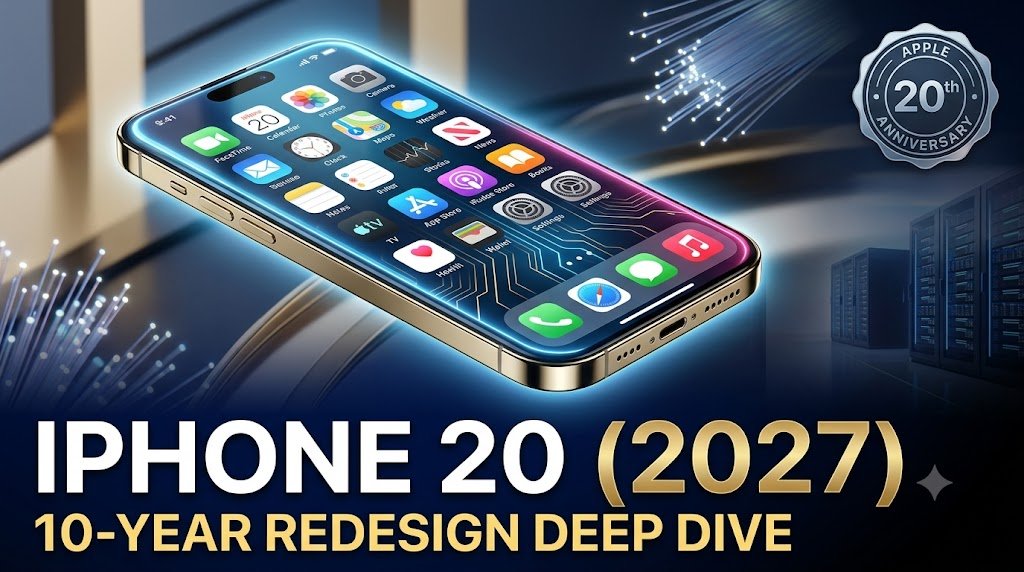
Ten years after the iPhone X eliminated the Home button and set the blueprint for modern smartphones, Apple is reportedly preparing another decade-defining shift. Commemorating 20 years since Steve Jobs unveiled the original iPhone in 2007, the expected 20th Anniversary iPhone (internally dubbed iPhone 20 or iPhone XX) is rumored for a Fall 2027 debut.
Supply chain reports and industry analysts—including Bloomberg’s Mark Gurman and leaker Ice Universe—indicate that Apple is planning its most ambitious hardware overhaul to date. Here is a comprehensive deep dive into every rumor, leak, and technical expectation surrounding Apple’s 2027 flagship.
Key Highlights at a Glance
- Naming Strategy: Skipping “iPhone 19” to launch as iPhone 20 or iPhone XX, mirroring the jump to iPhone X in 2017.
- Form Factor: Quad-curved “Liquid Glass” enclosure wrapping seamlessly around all four edges.
- Display: Near-zero bezels (~1.1mm) with under-display Face ID, phasing out the Dynamic Island.
- Controls: Full transition to solid-state haptic buttons (“Project Bongo”).
- Performance: A21 Pro chip built on a 2nm architecture with high-bandwidth memory.
- Power: Silicon-anode battery tech promising a major leap in energy density and battery life.
1. The Design: The “Single Sheet of Glass” Realized
The centerpiece of the 20th anniversary refresh is an all-glass quad-curved body. For over a decade, legendary former Apple design chief Jony Ive spoke of his dream to create an iPhone that looks and feels like a “single continuous slab of glass.” The 2027 flagship appears poised to make that vision a reality.
┌─────────────────────────────────────────┐
│     Seamless Quad-Curved Glass Surface  │
│  ┌───────────────────────────────────┐  │
│  │                                   │  │
│  │    No Cutouts / No Dynamic Island │  │
│  │   (Under-Display Face ID / Cam)   │  │
│  │                                   │  │
│  └───────────────────────────────────┘  │
│     Micro-Curved Edge (Light-Guiding)   │
└─────────────────────────────────────────┘
Micro-Curves Over “Waterfall” Edges
Unlike the aggressive, steep “waterfall” screens used by early curved Android smartphones, Apple is reportedly deploying an equal-depth micro-curved glass panel.
- Seamless Swiping: The glass curves gently on all four sides into an ultra-thin perimeter frame, eliminating harsh side edges.
- Visual Illusion: Rumors point to custom optical refraction layers and light-guiding structures within the glass to mask the physical bezel boundaries entirely, creating the visual effect of screen content floating directly on the shell.
2. Display & Sensors: Goodnight, Dynamic Island
Since the iPhone 14 Pro, the Dynamic Island has served as Apple’s functional compromise for housing the TrueDepth camera system. The iPhone 20 aims to retire it in favor of an uninterrupted display.
| Feature | Current Flagships | iPhone 20 (2027 Rumored) |
| Front Cutout | Dynamic Island (Pill Cutout) | Completely Hole-Free Screen |
| Face ID | Visible Sensors in Screen Cutout | Under-Display IR Emitters & Receivers |
| Front Camera | Punch-hole / Pill Cutout | Micro-Transparent Under-Display Glass |
| Bezel Width | ~1.5mm – 2.0mm | ~1.1mm Quad-Curved Border |
| Display Sizes | 6.3″ / 6.9″ | ~6.3″ / ~6.96″ (Marketed as 7.0″) |
3. Physical Controls: Solid-State Haptics
Apple has long worked toward eliminating mechanical moving parts to boost water resistance and structural integrity. Code-named Project Bongo, the anniversary iPhone is expected to replace traditional volume keys, power, and utility buttons with solid-state capacitive surfaces powered by dedicated Taptic Engines.
- Pressure-Sensitive Zones: Buttons flush with the glass chassis detect localized force.
- Haptic Feedback: Micro-vibrations mimic the physical tactile “click” without any physical gap in the chassis.
4. Under the Hood: Silicon, Memory, and Battery
The exterior transformation is backed by critical advancements in internal architecture:
Apple A21 Pro (2nm Node)
The iPhone 20 is slated to feature the A21 Pro chip, expected to be manufactured on TSMC’s next-generation 2nm process node. Paired with High-Bandwidth Memory (HBM) integration, the chip is designed to power real-time on-device Generative AI models without thermal throttling or heavy power draw.
Silicon-Anode Battery Tech
To power a larger, brighter display within a sleek enclosure, Apple is reportedly pivoting toward pure silicon-anode battery technology. Silicon anodes offer vastly superior energy density compared to traditional graphite anodes, allowing up to 30%–50% higher energy capacity in the same physical footprint.
Proprietary Silicon Stack
Following its transition to in-house cellular connectivity, the 20th anniversary model will feature a second-generation Apple-designed 5G modem alongside custom-designed CMOS image sensors, moving away from off-the-shelf camera hardware.
What This Means for Apple’s Lineup
The 2027 anniversary model isn’t arriving in isolation. Industry roadmaps suggest a three-year strategic trajectory for Apple’s hardware strategy:
- Ultra-Thin Form Factors: Initiated with the ultra-thin chassis design language.
- Foldables: Arrival of Apple’s first book-style foldable iPhone.
- The Glass Slab (2027): The iPhone 20 serves as the crown jewel—establishing the non-folding, ultra-premium smartphone layout for the next decade.
As with the iPhone X in 2017—which raised the baseline flagship price to $999—the iPhone 20 is expected to command a premium price tag, with rumors pointing to starting prices around $1,399 to $1,499 for base configurations.



Simply wish to say your article is as astonishing. The clearness
in your post is simply spectacular and i can assume
you are an expert on this subject. Well with
your permission let me to grab your RSS feed to keep up
to date with forthcoming post. Thanks a million and please keep
up the enjoyable work.