The fragile ceasefire agreement signed between the United States and Iran has been pushed to the brink of collapse following a rapid sequence of military escalations in and around the strategic Strait of Hormuz.
The Incident: Attack on the M/V Ever Lovely
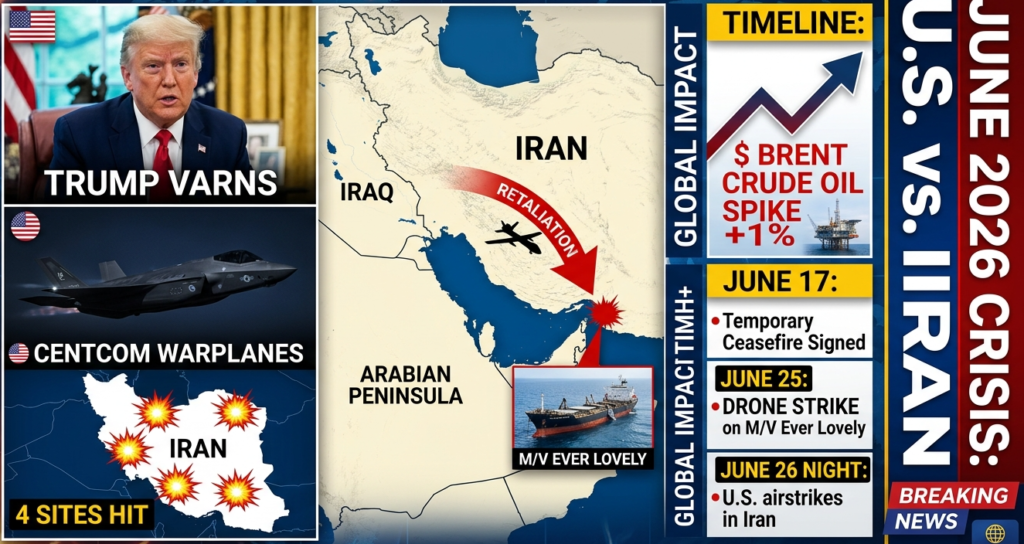
The escalation began on Thursday, June 25, 2026, when the M/V Ever Lovely, a Singapore-flagged container ship operated by Evergreen Marine, was targeted while exiting the Strait of Hormuz along the Omani coast.
According to U.S. officials, Iranian forces launched at least four one-way attack drones at maritime traffic. While U.S. forces successfully intercepted three of the drones, the fourth struck the upper deck of the cargo vessel. The ship sustained damage to its bridge windows but was able to continue its journey with its main engine and navigation equipment fully operational. No injuries were reported among the crew.
U.S. President Donald Trump quickly denounced the strike on social media, calling it a “foolish violation” of the bilateral Memorandum of Understanding (MoU) signed on June 17, which had established a temporary cessation of hostilities.
The U.S. Response: CENTCOM Airstrikes
In direct retaliation, U.S. Central Command (CENTCOM) coordinated a targeted aerial operation on Friday, June 26. Executed by F-35 and F-16 fighter jets, the 90-minute operation hit four specific locations—three along the Iranian coast and one on Qeshm Island in the Persian Gulf.
“U.S. Central Command forces conducted strikes against Iran as a powerful response to yesterday’s attack on a commercial ship transiting the Strait of Hormuz. U.S. aircraft struck Iranian missile and drone storage locations and coastal radar sites.”
— Official CENTCOM Statement
Vice President JD Vance, who served as the chief U.S. negotiator for the recent peace talks in Switzerland, backed the military action online, stating, “Iran signed a ceasefire agreement. We have honored it… But violence will be met with violence.”
Iranian Retaliation and Diplomatic Fallout
Following the American airstrikes, Iran’s Islamic Revolutionary Guard Corps (IRGC) claimed it attempted to thwart the U.S. operation near Sirik Island. In immediate retaliation, Iran launched series of counter-attacks targeting regional U.S. military installations.
The Iranian Foreign Affairs Ministry and parliamentary leaders condemned the U.S. response. Ebrahim Azizi, head of the Iranian Parliament’s National Security Commission, accused Washington of violating the ceasefire mid-negotiation, warning that the move would lead to “retreat and regret.”
| Key Event Timeline (June 2026) | Description |
| June 17 | U.S. and Iran sign a 14-point MoU establishing a temporary ceasefire. |
| June 25 | One-way attack drone strikes the Singapore-flagged M/V Ever Lovely. |
| June 26 (Day) | President Trump warns of consequences during an Oval Office briefing. |
| June 26 (Night) | CENTCOM warplanes bomb 4 drone/missile storage and radar sites in Iran. |
| Post-Strike | IRGC initiates counter-attacks on regional U.S. facilities; global Brent crude oil prices spike by over 1%. |
Global Economic and Maritime Impact
The immediate impact of the renewed hostilities was felt across global energy and shipping markets. Brent crude prices jumped by more than 1% to $73.50 a barrel shortly after the military actions were confirmed.
Concurrently, the International Maritime Organization (IMO) halted its ongoing evacuation framework intended to safely clear hundreds of stranded commercial vessels out of the Persian Gulf, stating that operations will not resume until absolute safety guarantees are re-established in the international trade corridor. CENTCOM has stated its forces remain highly vigilant and will continue providing parallel safe-passage coordination for commercial shipping transiting the strait.