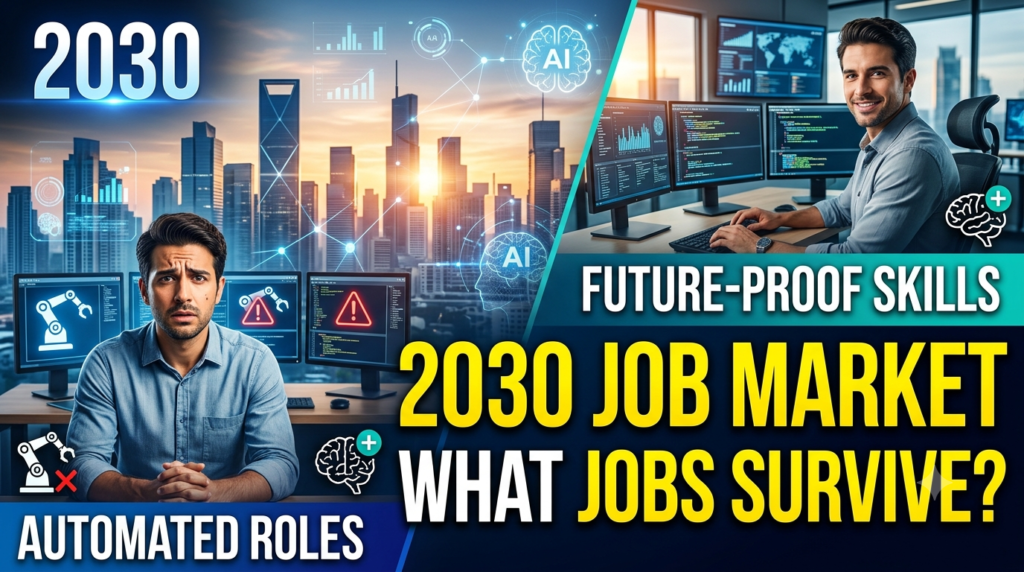
By 2030, AI will not necessarily eliminate entire professions overnight, but it will heavily automate routine, repetitive, pattern-based, and data-heavy tasks. The key pattern is clear: AI will replace tasks, reducing the number of entry-level and operational roles needed, while augmenting senior, strategic professionals who know how to leverage AI tools.
Here is a detailed breakdown of the jobs and sectors most at risk of major reduction or transformation by 2030:
1. Procurement, Logistics & Supply Chain Operations
Data analysis, pattern recognition, and predictive modeling make routine supply chain operations prime candidates for automation.
- Junior Procurement Officers & Tactical Buyers: Generating routine Purchase Orders (POs), processing purchase requisitions, comparing standard vendor quotes, and routine reordering are being fully automated via AI-driven ERP workflows. Human involvement will shift almost entirely to high-stakes supplier negotiations, strategic sourcing, and contract management.
- Warehouse & Inventory Clerks: Automated inventory management systems integrated with RFID, IoT, and predictive AI now track stock levels, forecast demand, and execute automatic replenishment with far higher accuracy than manual logging.
- Basic Logistics Coordinators: Route optimization, shipment tracking, and standard freight documentation management are handled end-to-end by logistics AI platforms.
2. Administrative, Finance & Back-Office Roles
Back-office administration involves structured rules and predictable data processing, making it highly susceptible to autonomous AI agents.
- Data Entry Clerks & Document Processors: Intelligent Document Processing (IDP), Advanced OCR, and Large Language Models (LLMs) extract, classify, and input data from invoices, contracts, and forms instantly, rendering manual data entry virtually obsolete.
- Bookkeepers & Basic Accounting Clerks: Routine ledger entries, invoice matching, basic tax prep, and financial reconciliations are automated inside modern cloud-accounting platforms.
- Routine Executive Assistants: Scheduling meetings, managing email triage, generating meeting summaries, and arranging travel logistics are increasingly handled by personal AI assistants integrated into corporate software suites.
3. Customer Support & Sales Telemarketing
Advancements in natural language processing and ultra-realistic voice AI are reshaping front-line communications.
- Tier-1 Customer Support Representatives: Level-1 support—handling basic FAQs, order tracking, returns, and standard troubleshooting—is rapidly transitioning to autonomous AI voicebots and conversational agents that operate 24/7 without fatigue.
- Cold Callers & Telemarketers: Automated conversational voice agents can conduct initial outbound outreach, qualify leads, and update CRM records at scale, replacing traditional outbound telemarketing teams.
4. Entry-Level Software Engineering & Tech Support
Generative AI has radically accelerated code generation, debugging, and quality assurance.
- Junior Software Developers & Coders: AI tools can now write boilerplate code, fix syntax bugs, and translate code between languages in seconds. Companies will need fewer junior coders to write basic code; instead, the focus will shift to senior engineers managing and auditing AI-generated output.
- Manual Software QA & Test Engineers: Automated test case generation and AI bug detection tools are replacing manual click-through and script testing.
- Level-1 IT Helpdesk Technicians: Basic IT troubleshooting (e.g., password resets, software installation guides, system access grants) is being routed through conversational internal IT bots.
5. Content Creation, Translation & Digital Marketing
Text-based and visual content generation was among the first areas disrupted by generative AI.
- Routine Content & SEO Writers: Generic blogging, basic product descriptions, and low-complexity SEO articles are heavily automated. Demand is shrinking for writers who produce standard informational copy without deep subject-matter expertise or unique personal perspective.
- Junior Graphic Designers: Basic asset creation—such as social media banners, simple promotional flyers, and background removals—can be instantly generated via image generation models.
- Standard Translators: Machine translation powered by neural networks handles standard document and subtitle translation with high speed and accuracy, reserving human translators for nuanced localization, legal contracts, and literary work.
6. Transportation & Fleet Operations
While complete full-autonomy across all terrains will take time, structured transportation routes are heading toward automation.
- Long-Haul Trucking & Middle-Mile Freight: Fixed highway routes and depot-to-depot transit are early adoption zones for autonomous trucks, reducing the need for human drivers on long-distance interstate routes.
- Rideshare & Taxi Drivers (Geofenced Zones): Autonomous robotaxi fleets are expanding rapidly in major urban hubs for predictable, mapped routes.
Which Roles Remain Safe?
Jobs that rely on skills AI cannot easily replicate will remain resilient:
- Strategic & High-Stakes Decision Making: Executive leadership, complex commercial negotiations, cross-department strategy, and crisis management.
- Emotional Intelligence & Complex Human Dynamics: Organizational leadership, deep client relationship management, specialized coaching, and mental healthcare.
- Skilled Physical Trades: Electricians, plumbers, specialized mechanics, and site supervisors—roles operating in unpredictable, non-standardized physical environments that hardware robotics cannot easily navigate.
The core shift by 2030 is not simply that “AI takes your job,” but rather a professional utilizing AI will replace a professional who does not. Adaptation and mastering AI workflows within your domain will be the single biggest factor in long-term career resilience.